Summary

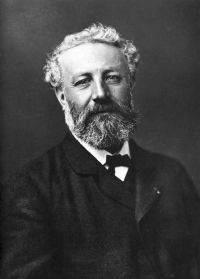
Portrait of Jules Verne Jules Verne,  Mathias Sandorf — Chapter XII (1885)

“ Between the two shores, cut by the prows of the rapid steamers that stop not for wind or wave, and the sailing vessels that the westerly winds keep back at times in hundreds, there stretches the expanse of ever-moving water, ever changing, here gray and streaked with foam, there blue and calm, and broken into restless bills that mark the zigzagged current-line. No one can remain insensible to the sublime beauties that the two continents, Europe and Africa, bring face to face along the double panorama of the Straits of Gibraltar.
Swiftly does the “Ferrato” approach the African coast.
”
Source: Wikisource

Portrait of Jules Verne Jules Verne,  Mathias Sandorf — Chapter XII (1885)

“ Are you going to stay here any time?”
“Four or five hours at the most,” said the doctor, “I must leave to-night for Gibraltar, where I have an appointment to-morrow morning.”
“Leave this evening!” exclaimed the governor. “Allow me to insist! I assure you, Doctor Antekirtt, that our military colony is worth studying thoroughly! You have doubtless seen much and observed much during your travels, but perhaps have not paid much attention to the question of prison discipline; and I assure you that Ceuta is worth study, not only by scientific men, but by economists.”
”
Source: Wikisource

Portrait of Jules Verne Jules Verne,  Mathias Sandorf — Chapter XII (1885)

“ For example, to-morrow, or the day after, or a week after, or six months after, even if he has awoke, if I desire him to leave Ceuta he will leave Ceuta!”
“Leave Ceuta!” said Pierre. “Gain his liberty! But will the warders let him? The influence of the suggestion can not make him break his chain, nor open the prison gate, nor scale an unscalable wall—”
“No Pierre,” replied the doctor, “I can not compel him to do what I could not do myself, and it is for that reason that I am now on my way to visit the Governor of Ceuta.”
”
Source: Wikisource

Get perspective with Kwize: daily news enlightened by great literature