Summary

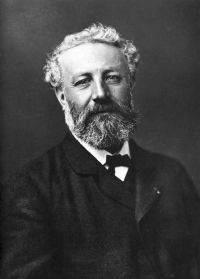
Portrait of Jules Verne Jules Verne,  Michael Strogoff (1876) — Chapter III (1876)

“ In a few moments Michael Strogoff, the courier, entered the imperial library. He was a tall, vigorous, broad-shouldered, deep-chested man. His powerful head possessed the fine features of the Caucasian race. His well-knit frame seemed built for the performance of feats of strength. It would have been a difficult task to move such a man against his will, for when his feet were once planted on the ground, it was as if they had taken root. ”
Source: Wikisource

Portrait of Jules Verne Jules Verne,  Michael Strogoff (1876) — Chapter III (1876)

“ The Czar appeared satisfied with Strogoff's calm and simple answer.
"Go then, Michael Strogoff," said he, "go for God, for Russia, for my brother, and for myself!"
The courier, having saluted his sovereign, immediately left the imperial cabinet, and, in a few minutes, the New Palace.
"You made a good choice there, General," said the Czar.
"I think so, sire," replied General Kissoff; "and your majesty may be sure that Michael Strogoff will do all that a man can do."
"He is indeed a man," said the Czar.
”
Source: Wikisource

Portrait of Jules Verne Jules Verne,  Michael Strogoff (1876) — Chapter III (1876)

“ The only sentiment of love felt by Michael Strogoff was that which he entertained for his mother, the aged Marfa, who could never be induced to leave the house of the Strogoffs, at Omsk, on the banks of the Irtish, where the old huntsman and she had lived so long together. When her son left her, he went away with a full heart, but promising to come and see her whenever he could possibly do so; and this promise he had always religiously kept.
When Michael was twenty, it was decided that he should enter the personal service of the Emperor of Russia, in the corps of the couriers of the Czar.
”
Source: Wikisource

Get perspective with Kwize: daily news enlightened by great literature