Summary

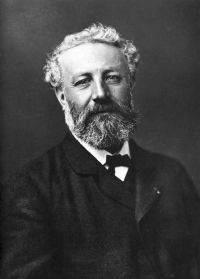
Portrait of Jules Verne Jules Verne The Adventures of Three Englishmen and Three Russians in Southern Africa…

The hunter listened again, but again heard nothing.
“Mokoum,” then said Mr. William Emery, “if the noise you thought you heard is caused by the machinery of a steamboat, you would hear better by stooping to the level of the river; water always conducts sound more clearly and quickly than air.”
“You are right, Mr. William,” answered Mokoum, “for more than once I have found out the passage of a hippopotamus across the river in that way.”
The bushman went nimbly down the bank, clinging to the creepers and tufts of grass on his way.
Source: Wikisource

Portrait of Jules Verne Jules Verne The Adventures of Three Englishmen and Three Russians in Southern Africa…

Accustomed as he was to bend over his figures and catalogues day and night, hardly ever leaving the eye-piece of his telescope, watching the passage of stars across the meridian and their occupations, he delighted in the open-air life in the almost impenetrable woods which covered the slope of the hills, and on the lonely peaks that were sprinkled by the spray from the Morgheda as with a damp dust.
Source: Wikisource

Portrait of Jules Verne Jules Verne The Adventures of Three Englishmen and Three Russians in Southern Africa…

William,” said the hunter, “why shouldn't we go to meet these strangers? We cannot miss them; there is only one road, that by the river, and if they are coming up, as your bit of paper says they are, we are sure to meet them.”
“That is a capital idea of yours, Mokoum,” replied the astronomer: “we will go on and look out below the falls. We can get back to the encampment by the side valleys in the south. But tell me, my good bushman, you know nearly the whole course of the river, do you not?”
Source: Wikisource

Get perspective with Kwize: daily news enlightened by great literature