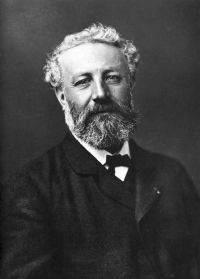
Jules Verne

Jules Verne

Summary

Portrait of Jules Verne Jules Verne The Green Ray — Chapter II (1883)

She was a thorough manager: serious, orderly, skilful, superintending the whole household. Perhaps she imagined that she had reared the two brothers, although they were older than herself, but most certainly she had bestowed maternal care on Miss Campbell.
Next to this valuable stewardess figured Partridge, a servant entirely devoted to his masters, always faithful to the time-honoured customs of his clan, and invariably dressed in Highland costume.
Source: Wikisource

Portrait of Jules Verne Jules Verne The Green Ray — Chapter II (1883)

Beyond the narrow gulf on the right the eye rests on the peninsula of Roseneath, on which stands a pretty Italian villa, belonging to the Duke of Argyll; to the left lies the little hamlet of Helensburgh, with its undulating line of houses along the coast, and here and there the spire of a church; its elegant pier running out into the waters of the lake for the service of steamers, and its background of hills enlivened with picturesque villas.
Source: Wikisource

Portrait of Jules Verne Jules Verne The Green Ray — Chapter II (1883)

It has doubtless been remarked that when Partridge answered the brothers' call he had spoken of their niece as Miss Campbell.
Had the Scotchman given her her baptismal name, and called her Miss Helena, he would have committed an infraction of Highland etiquette; never indeed is the eldest or the only daughter of good family called by her Christian name. If Miss Campbell had been the daughter of a peer, she would have been called Lady Helena.
Source: Wikisource

Get perspective with Kwize: daily news enlightened by great literature