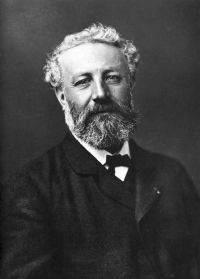
Jules Verne

Jules Verne

Summary

Portrait of Jules Verne Jules Verne,  The Green Ray — Chapter IV (1883)

“ When their luggage had been put on board, Miss Campbell and her companions immediately embarked.
At this moment the bell summoning all tardy passengers rang out for the third and last time; the engines began to work, the paddle-wheels lashed the yellow water into foam, a shrill whistle sounded, the moorings were loosened, and the Columbia sped rapidly away with the tide.
Tourists in the United Kingdom have no cause for complaint, the companies everywhere place magnificent boats at their disposal.
”
Source: Wikisource

Portrait of Jules Verne Jules Verne,  The Green Ray — Chapter IV (1883)

“ There is hardly a piece of water so inconsiderable, a lake so small, or a gulf so unimportant, but what is every day ploughed by fine steam-packets. It is not to be wondered at that the Clyde should be one of the most favoured in this respect. Thus, the whole length of Broomielaw Street, alongside the wharfs of the steamboat quay were numbers of packets, with their paddle-boxes painted the brightest colours, from gold to vermilion, with steam up, ready to set off in all directions.
The Columbia was no exception to this rule
”
Source: Wikisource

Portrait of Jules Verne Jules Verne,  The Green Ray — Chapter IV (1883)

“ She did not even look at the ruins of Cardross Castle, where Robert Bruce died. A sea-horizon was what she vainly sought; but there was no chance of getting one till the Columbia had passed this succession of banks, promontories, and hill-sides, which bound the Frith of Clyde. Besides, the steamer was then passing the town of Helensburgh, Port Glasgow, the ruins of Newark Castle, and the peninsula of Roseneath, which she could see any day from her own home. And she began to wonder whether the steamer was going up the stream, winding through the park. ”
Source: Wikisource

Get perspective with Kwize: daily news enlightened by great literature