Summary

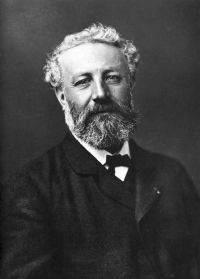
Portrait of Jules Verne Jules Verne The Voyages and Adventures of Captain Hatteras…

Seldom has man been called upon to endure so low a temperature.
The ice stretched in long, dark lines upon the floor; a dense mist filled the room; the dampness fell in the form of thick snow; the men could not see one another; their extremities grew cold and blue; their heads felt as if they wore an iron band; and their thoughts grew confused and dull, as if they were half delirious. A terrible symptom was that their tongues refused to articulate a sound.
From the day the men threatened to burn the ship, Hatteras would walk for hours upon the deck, keeping watch.
Source: Wikisource

Portrait of Jules Verne Jules Verne The Voyages and Adventures of Captain Hatteras…

Bell, with Altamont's aid, ran to the sledge; he brought one of the uprights, stood it up on the floe for a mast, making it fast with ropes; the tent was torn up for a sail. The wind was fair; the poor castaways put out to sea on this frail raft.
Two hours later, after unheard-of efforts, the last men of the Forward were taken aboard the Danish whaler Hans Christian, which was sailing to Davis Strait.
The captain received kindly these spectres who had lost their semblance to human beings; when he saw their sufferings he understood their history
Source: Wikisource

Portrait of Jules Verne Jules Verne The Voyages and Adventures of Captain Hatteras…

He followed the doctor, Johnson, and Bell to Liverpool, where they were warmly received, after they had been thought to be long dead, and buried in the eternal ice.
But Dr. Clawbonny always gave the glory to the man who most deserved it. In his account of the journey entitled The English at the North Pole, published the next year by the Royal Geographical Society, he made John Hatteras equal to the greatest explorers, the rival of those bold men who sacrifice everything to science.
Source: Wikisource

Get perspective with Kwize: daily news enlightened by great literature