Summary

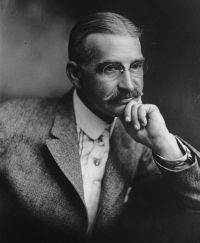
Portrait of L. Frank Baum L. Frank Baum The Flying Girl — 17. A Curious Accident (1911)

From the far end of the field Steve swung around and started back, straight for the grand stand. He had nearly reached it when he threw in the clutch that started the propellers and at the same time slightly elevated the front rudder. Up, like a bird taking wing, rose the aircraft, soaring above the grand stand and then describing a series of circles over the field. Gradually it ascended, as if the aviator was ascending an aërial spiral staircase, until he had mounted so far among the clouds that only a grayish speck was discernible.
Source: Wikisource

Portrait of L. Frank Baum L. Frank Baum The Flying Girl — 17. A Curious Accident (1911)

Women screamed, men paled and more than one onlooker turned sick and faint.
For the Kane Aircraft, while gracefully gliding along, in full view of all, was seen to suddenly collapse and crumple like a pricked toy balloon. Aëroplane and aviator fell together in a shapeless mass toward the earth, and the sight was enough to dismay the stoutest heart.
But Steve’s salvation lay in his altitude at the time of the accident. Fifty feet from the earth the automatic planes asserted their surfaces against the air and arrested, to an appreciable extent, the plunge.
Source: Wikisource

Portrait of L. Frank Baum L. Frank Baum The Flying Girl — 17. A Curious Accident (1911)

Those who knew something of aviation, however, were the ones astonished at Steve’s preliminary performance. They realized the advantage of being able to drive an aëroplane on its own wheels, as an automobile goes, in case of emergencies, and moreover the “crossed planes”—a distinct innovation in construction—gave them considerable food for thought. Usually the two surfaces, or floats, of a biplane are exactly parallel, one above the other; but in Steve’s machine the upper plane ran fore and aft, while the lower one extended sidewise.
Source: Wikisource

Get perspective with Kwize: daily news enlightened by great literature