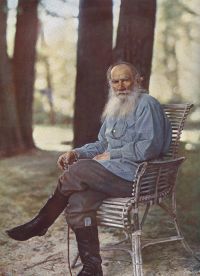
Leo Tolstoy

Leo Tolstoy

Summary

Portrait of Leo Tolstoy Leo Tolstoy A Confession — II (1882)

The view of life of these people, my comrades in authorship, consisted in this: that life in general goes on developing, and in this development we—men of thought—have the chief part; and among men of thought it is we—artists and poets—who have the greatest influence. Our vocation is to teach mankind. And lest the simple question should suggest itself: What do I know, and what can I teach? it was explained in this theory that this need not be known, and that the artist and poet teach unconsciously.
Source: Wikisource

Portrait of Leo Tolstoy Leo Tolstoy A Confession — II (1882)

And thousands of us, contradicting and abusing one another, all printed and wrote—teaching others. And without noticing that we knew nothing, and that to the simplest of life's questions: What is good and what is evil?
Source: Wikisource

Portrait of Leo Tolstoy Leo Tolstoy A Confession — II (1882)

I cannot think of those years without horror, loathing and heartache. I killed men in war and challenged men to duels in order to kill them. I lost at cards, consumed the labour of the peasants, sentenced them to punishments, lived loosely, and deceived people. Lying, robbery, adultery of all kinds, drunkenness, violence, murder—there was no crime I did not commit, and in spite of that people praised my conduct and my contemporaries considered and consider me to be a comparatively moral man.
So I lived for ten years.
During that time I began to write from vanity, covetousness, and pride.
Source: Wikisource

Get perspective with Kwize: daily news enlightened by great literature