Luís Vaz de Camões

Luís Vaz de Camões

The Lusiad (1791)

Summary

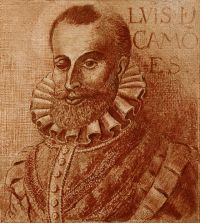
Portrait of Luís Vaz de Camões Luís Vaz de Camões The Lusiad (1791)

Luis de Camoëns, the author of the Lusiad, was born at Lisbon about A.D. 1524. His misfortunes began with his birth--he never saw a father’s smile - for Simon Vasco de Camoëns perished by shipwreck in the very year which gave being to his illustrious son. The future poet was sent to the university of Coimbra--then at the height of its fame,--"and maintained there by the provident care of his surviving parent."
"Love," says Lord Strangford, "is very nearly allied to devotion, and it was in the exercise of the latter, that Camoëns was introduced to the knowledge of the former.
Source: Wikisource

Portrait of Luís Vaz de Camões Luís Vaz de Camões The Lusiad (1791)

For his own performance Musgrave claims the merit of greater fidelity to the original; but in respect of harmony, in true poetic grace, and sublimity of diction, his translation will bear no comparison with Mickle’s version; for even Southey, in the article before quoted, though very hard upon his interpolations, admits that, "Mickle was a man of genius . . . a man whom we admire and respect; whose memory is without a spot, and whose name will live among the English poets."
Source: Wikisource

Portrait of Luís Vaz de Camões Luís Vaz de Camões The Lusiad (1791)

In one of the engagements with the enemy our hero had the misfortune to lose "his right eye, by some splinters from the deck of the vessel in which he was stationed. Many of his most pathetic compositions were written during this campaign, and the toils of a martial life were sweetened by the recollection of her for whose sake they were endured.
Source: Wikisource

Get perspective with Kwize: daily news enlightened by great literature