Summary

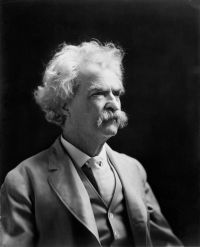
Portrait of Mark Twain Mark Twain A Connecticut Yankee in King Arthur's Court… (1889)

Within the next mile we counted six more hanging forms by the blaze of the lightning, and altogether it was a grisly excursion. That murmur was a murmur no longer, it was a roar; a roar of men's voices. A man came flying by now, dimly through the darkness, and other men chasing him. They disappeared. Presently another case of the kind occurred, and then another and another. Then a sudden turn of the road brought us in sight of that fire—it was a large manor-house, and little or nothing was left of it—and everywhere men were flying and other men raging after them in pursuit.
Source: Wikisource

Portrait of Mark Twain Mark Twain A Connecticut Yankee in King Arthur's Court… (1889)

We started down the hill in its direction, and the winding road plunged us at once into almost solid darkness—darkness that was packed and crammed in between two tall forest walls. We groped along down for half a mile, perhaps, that murmur growing more and more distinct all the time. The coming storm threatening more and more, with now and then a little shiver of wind, a faint show of lightning, and dull grumblings of distant thunder.
Source: Wikisource

Portrait of Mark Twain Mark Twain A Connecticut Yankee in King Arthur's Court… (1889)

And there was only one redeeming feature connected with that pitiful piece of history; and that was, that secretly the "poor white" did detest the slave-lord, and did feel his own shame. That feeling was not brought to the surface, but the fact that it was there and could have been brought out, under favoring circumstances, was something—in fact, it was enough; for it showed that a man is at bottom a man, after all, even if it doesn't show on the outside.
Well, as it turned out, this charcoal burner was just the twin of the Southern "poor white" of the far future.
Source: Wikisource

Get perspective with Kwize: daily news enlightened by great literature