Summary

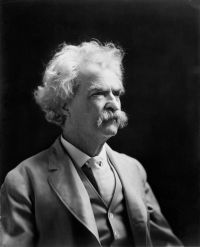
Portrait of Mark Twain Mark Twain Life on the Mississippi — Chapter 60 (1883)

One deafening yell from the lover warrior is heard above the cries of hundreds of his tribe, and dashing away to his wigwam he grasps his faithful knife, returns almost at a single bound to the scene of fear and fright, rushes out along the leaning tree to the spot where his treasure fell, and springing with the fury of a mad panther, pounced upon his prey. The animal turned, and with one stroke of his huge paw brought the lovers heart to heart, but the next moment the warrior, with one plunge of the blade of his knife, opened the crimson sluices of death, and the dying bear relaxed his hold.
Source: Wikisource

Portrait of Mark Twain Mark Twain Life on the Mississippi — Chapter 60 (1883)

The sun had again set upon the 'sugar-bush,' and the bright moon rose high in the bright blue heavens, when the young warrior took down his flute and went out alone, once more to sing the story of his love, the mild breeze gently moved the two gay feathers in his head-dress, and as he mounted on the trunk of a leaning tree, the damp snow fell from his feet heavily. As he raised his flute to his lips, his blanket slipped from his well-formed shoulders, and lay partly on the snow beneath.
Source: Wikisource

Portrait of Mark Twain Mark Twain Life on the Mississippi — Chapter 60 (1883)

She took her place beside him, and for the present they were happy; for the Indian has a heart to love, and in this pride he is as noble as in his own freedom, which makes him the child of the forest. As the legend runs, a large white-bear, thinking, perhaps, that polar snows and dismal winter weather extended everywhere, took up his journey southward. He at length approached the northern shore of the lake which now bears his name, walked down the bank and made his way noiselessly through the deep heavy snow toward the island.
Source: Wikisource

Get perspective with Kwize: daily news enlightened by great literature