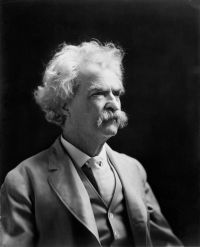
Mark Twain

Mark Twain

Summary

Portrait of Mark Twain Mark Twain Roughing It — Chapter XXI (1872)

Instantly he shouted:
"Turn out, boys—the tarantulas is loose!"
No warning ever sounded so dreadful. Nobody tried, any longer, to leave the room, lest he might step on a tarantula. Every man groped for a trunk or a bed, and jumped on it. Then followed the strangest silence—a silence of grisly suspense it was, too—waiting, expectancy, fear. It was as dark as pitch, and one had to imagine the spectacle of those fourteen scant-clad men roosting gingerly on trunks and beds, for not a thing could be seen.
Source: Wikisource

Portrait of Mark Twain Mark Twain Roughing It — Chapter XXI (1872)

But seriously a Washoe wind is by no means a trifling matter. It blows flimsy houses down, lifts shingle roofs occasionally, rolls up tin ones like sheet music, now and then blows a stage coach over and spills the passengers; and tradition says the reason there are so many bald people there, is, that the wind blows the hair off their heads while they are looking skyward after their hats. Carson streets seldom look inactive on Summer afternoons, because there are so many citizens skipping around their escaping hats, like chambermaids trying to head off a spider.
Source: Wikisource

Portrait of Mark Twain Mark Twain Roughing It — Chapter XXI (1872)

The "Washoe Zephyr" (Washoe is a pet nickname for Nevada) is a peculiar Scriptural wind, in that no man knoweth "whence it cometh." That is to say, where it originates. It comes right over the mountains from the West, but when one crosses the ridge he does not find any of it on the other side! It probably is manufactured on the mountain-top for the occasion, and starts from there. It is a pretty regular wind, in the summer time.
Source: Wikisource

Get perspective with Kwize: daily news enlightened by great literature