Summary

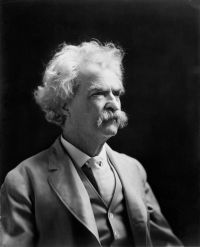
Portrait of Mark Twain Mark Twain,  The Innocents Abroad — Chapter XXVIII. (1869)

“ In their Vatican is stored up all that is curious and beautiful in art; in our Patent Office is hoarded all that is curious or useful in mechanics. When a man invents a new style of horse-collar or discovers a new and superior method of telegraphing, our government issues a patent to him that is worth a fortune; when a man digs up an ancient statue in the Campagna, the Pope gives him a fortune in gold coin. We can make something of a guess at a man’s character by the style of nose he carries on his face. ”
Source: Wikisource

Portrait of Mark Twain Mark Twain,  The Innocents Abroad — Chapter XXVIII. (1869)

“ I like to look at statues, however, and I like to look at pictures, also—even of monks looking up in sacred ecstacy, and monks looking down in meditation, and monks skirmishing for something to eat—and therefore I drop ill nature to thank the papal government for so jealously guarding and so industriously gathering up these things; and for permitting me, a stranger and not an entirely friendly one, to roam at will and unmolested among them, charging me nothing, and only requiring that I shall behave myself simply as well as I ought to behave in any other man’s house. ”
Source: Wikisource

Portrait of Mark Twain Mark Twain,  The Innocents Abroad — Chapter XXVIII. (1869)

“ VAULTS OF THE CONVENT.
“How many departed monks were required to upholster these six parlors?”
“These are the bones of four thousand.”
“It took a long time to get enough?”
“Many, many centuries.”
“Their different parts are well separated—skulls in one room, legs in another, ribs in another—there would be stirring times here for a while if the last trump should blow. Some of the brethren might get hold of the wrong leg, in the confusion, and the wrong skull, and find themselves limping, and looking through eyes that were wider apart or closer together than they were used to.
”
Source: Wikisource

Get perspective with Kwize: daily news enlightened by great literature