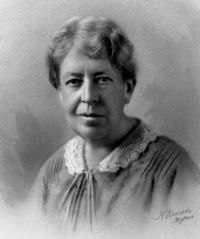
Mary Whiton Calkins

Mary Whiton Calkins

Summary

Portrait of Mary Whiton Calkins Mary Whiton Calkins Bertrand Russell on Neo-Realism (1915)

But he retains the ultimate distinctness of subject and object of knowledge. From the charge of holding so comprehensible a position Russell, however, is unhappily freed by his cavalier treatment of the self. In Russell’s view, consciousness is a sui generis relation called experience, or acquaintance, or awareness, between the subject, “an entity which is acquainted with something,” and the object, “any entity with which something is acquainted” (p. 438. Cf.p. 1) . But nothing can be known about the subject-term of this relation.
Source: Wikisource

Portrait of Mary Whiton Calkins Mary Whiton Calkins Bertrand Russell on Neo-Realism (1915)

Russell, though an expert logician and often a good (if amateur) psychologist, does not always distinguish between logical validity and actual experience. No formal difficulty is involved in treating the subject as a referent and in regarding consciousness as a relation distinct from the subject. But, inconvenient as the fact may be from the standpoint of the logical formula, consciousness as actually experienced and as normally described is a self being conscious.
Source: Wikisource

Portrait of Mary Whiton Calkins Mary Whiton Calkins Bertrand Russell on Neo-Realism (1915)

In fact, as Russell is at pains to urge, in a later article (p. 591) , “a knowledge of physics and physiology must not be assumed in theory of knowledge.”
Neutral monism, in the third place, is entirely unable to account for the individuality of experience. A’s experiencing of an object is one fact, and B’s experiencing of the object is another fact, and neutral monism has no terms in which to describe the distinction (p. 438) .
A final objection to neutral monism is its inability to account for error.
Source: Wikisource

Get perspective with Kwize: daily news enlightened by great literature