Summary

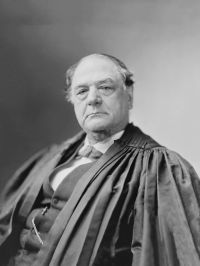
Portrait of Noah Haynes Swayne Noah Haynes Swayne White v. Hart — Opinion of the Court

Georgia, after her rebellion and before her representation was restored, has no more power to grant a title of nobility, to pass a bill of attainder, an ex post facto law, or law impairing the obligation of contracts, or to do anything else prohibited to her by the Constitution of the United States, than she had before her rebellion began, or after her restoration to her normal position in the Union. It is well settled by the adjudications of this court, that a State can no more impair the obligation of a contract by adopting a constitution than by passing a law.
Source: Wikisource

Portrait of Noah Haynes Swayne Noah Haynes Swayne White v. Hart — Opinion of the Court

The government of the Nation and the government of the States are each alike absolute and independent of each other in their respective spheres of action; but the former is as much a part of the government of the people of each State, and as much entitled to their allegiance and obedience as their own local State governments-'the Constitution of the United States and the laws made in pursuance thereof,' being in all cases where they apply, the supreme law of the land.
Source: Wikisource

Portrait of Noah Haynes Swayne Noah Haynes Swayne White v. Hart — Opinion of the Court

Nothing can be more material to the obligation than the means of enforcement.' Without the remedy, the contract may indeed, in the sense of the law, be said not to exist, and its obligation to fall within the class of those moral and social duties, which depend for their fulfilment wholly upon the will of the individual. The ideas of validity and remedy are inseparable and both are parts of the obligation which is guaranteed by the Constitution against invasion.
Source: Wikisource

Get perspective with Kwize: daily news enlightened by great literature