Summary

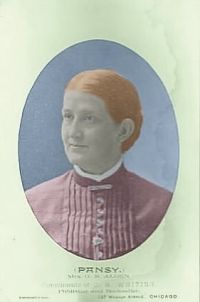
Portrait of Pansy Pansy Danger Cliff, and other stories (1884)

But you should see her when Mornie—that's the homely bird's name—makes up his mind to sing. She retires to the most distant corner of her cage, curls herself up in a still little heap, puts her head on one side, and listens without the flutter of a feather. Either I imagine it or there really does come a sad look in her eyes, as though she thought she would give all the yellow in her lovely tail if she could sing like that.
Oh, how he sings! Sometimes like a canary, sometimes like a wood-robin in a spring morning, sometimes like the true mate of the pretty little goldfinch herself.
Source: Gutenberg

Portrait of Pansy Pansy Danger Cliff, and other stories (1884)

Isn't it a wonder that Mornie never tries to talk? Perhaps he does try, but he never succeeds. I often feel sorry for him, to think that when he knows so much, he cannot learn to speak one little word. However, he gives me a great deal of pleasure with his music; as much as goldfinch does with her pretty ways and her gay dress; both of them are cheerful and happy all day long, and do just as well as they know how. Without any judgment, or reason, or soul, each contrives to do well and joyfully just what God wants him to do.
Source: Gutenberg

Portrait of Pansy Pansy Danger Cliff, and other stories (1884)

Just think what great pains people take, and how much money they spend to find out something about those worlds which twinkle all about us at night. The first chance you have to look through a good telescope, be sure to do it. Do you know I never look through one and see the wonders flashed before me, but I am reminded of the eye of God. How many things he sees that we cannot see at all. Things going on all about us, of which we know nothing. Think of a telescope that would show other people the thoughts of our hearts.
Source: Gutenberg

Get perspective with Kwize: daily news enlightened by great literature