Summary

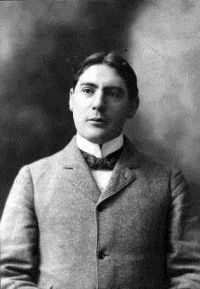
Portrait of Parke H. Davis Parke H. Davis St. Nicholas — Foot-Ball:The Full-Field Run from Kick-off to Touch-down… (1913)

The Harvard men did not mass upon him in that primitive day as would now occur, but met him with a scattered formation. Through this broken field Watson raced and dodged, flinging off tackler after tackler, and crossed the line, scoring the first touch-down ever scored against Harvard by Yale; Yale's previous victories were achieved by goals from the field.
Source: Wikisource

Portrait of Parke H. Davis Parke H. Davis St. Nicholas — Foot-Ball:The Full-Field Run from Kick-off to Touch-down… (1913)

In an open field, it is not difficult to dodge one and two tacklers in succession, but it is extraordinarily difficult in an open-field dash to dodge an entire eleven. Hence, on a full-field run from kick-off, fortune favors the bold runner who directs his flight squarely into the central bulwark of the defenders, and not at their apparently exposed flanks resting against the side-line. While the kick-off, substantially in the form of the present day, always has been possible under the rules, in practice it has not always been a method of play.
Source: Wikisource

Portrait of Parke H. Davis Parke H. Davis St. Nicholas — Foot-Ball:The Full-Field Run from Kick-off to Touch-down… (1913)

It also places the ball in the arms of a less formidable back, since the best running back invariably is stationed in front of the goal-posts. Most important of all, it does away with that colliding mass at the center of the field which, by the inexplicable combination of chances alone, makes possible the bursting through of the runner. Fortunately for those who desire to see, some day, a full-field run from kick-off, the corner kick-off involves the danger of a kick out of bounds, and so cannot be regularly employed.
Source: Wikisource

Get perspective with Kwize: daily news enlightened by great literature