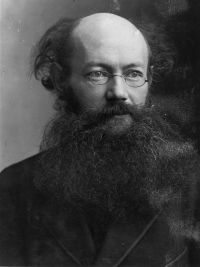
Peter Alexeivitch Kropotkin

Peter Alexeivitch Kropotkin

Summary

Portrait of Peter Alexeivitch Kropotkin Peter Alexeivitch Kropotkin The Commune of Paris (1896)

And yet, if we admit that a Central Government to regulate the relations of Communes between themselves is quite needless, why should we admit its necessity to regulate the mutual relations of the groups which make up each Commune? And if we leave the business of coming to a common understanding with regard to enterprises which concern several cities at once to the free initiative of the Communes concerned, why refuse this same free initiative to the groups composing a single Commune? There is no more reason for a government inside the Commune than for a government outside.
Source: Wikisource

Portrait of Peter Alexeivitch Kropotkin Peter Alexeivitch Kropotkin The Commune of Paris (1896)

The idea is sinking deep into the masses, it is giving them a rallying cry. We count on the present generation to bring about the Social Revolution within the Commune, to put an end to the ignoble system of middle-class exploitation, to rid the people of the tutelage of the State, to inaugurate a new era of liberty, equality, solidarity in the evolution of the human race.
Source: Wikisource

Portrait of Peter Alexeivitch Kropotkin Peter Alexeivitch Kropotkin The Commune of Paris (1896)

Any central government, taking upon itself to rule a nation, must certainly be a mere hindrance to the Revolution. It cannot fail to be made up of the most incongruous elements, and its very essence as a government is Conservatism. It will do nothing but hold back the Revolution in Communes ready to go ahead, without being able to inspire backward Communes with the breath of revolution. The same within a Commune in revolt. Either the Communal government will merely sanction accomplished facts—and then it will be a useless and dangerous bit of machinery
Source: Wikisource

Get perspective with Kwize: daily news enlightened by great literature