Summary

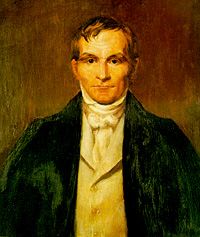
Portrait of Philip Pendleton Barbour Philip Pendleton Barbour William Bradley v. Washington Alexandria and Georgetown Steam Packet Company…

We think that the rule of law, which admits extrinsic evidence for the purpose of applying a written contract to its subject matter, justifies its admission, beyond the mere designation of the thing, or corpus, if we may so express it, on which the contract operates, and extends so far as to embrace the circumstances which accompany the transaction
Source: Wikisource

Portrait of Philip Pendleton Barbour Philip Pendleton Barbour William Bradley v. Washington Alexandria and Georgetown Steam Packet Company…

That extrinsic evidence is not admissible to explain a patent ambiguity; that is, one apparent on the face of the instrument: but that it is admissible to explain a latent ambiguity; that is, one not apparent on the face of the instrument, but one arising from extrinsic evidence; for this is but to remove the ambiguity by the same kind of evidence as that by which it is created. The rule thus stated seems to be in itself quite plain and intelligible, and yet much difficulty has arisen in its application.
Source: Wikisource

Portrait of Philip Pendleton Barbour Philip Pendleton Barbour William Bradley v. Washington Alexandria and Georgetown Steam Packet Company…

Gibbs, Chief Justice, said: evidence may be received to show the sense in which the mercantile part of the nation use the term privilege, just as you would look into a dictionary to ascertain the meaning of a word; and it must be taken to be used by the parties in its mercantile and established sense.
So where a charter party stipulated that a freighter should pay a certain sum per pound, &c., British weight; it was held, that as the word weight had two meanings, gross and neat, this was such a latent ambiguity as to warrant the introduction of parol testimony.
Source: Wikisource

Get perspective with Kwize: daily news enlightened by great literature