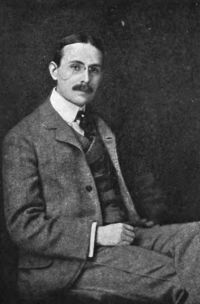
Ralph Henry Barbour

Ralph Henry Barbour

Summary

Portrait of Ralph Henry Barbour Ralph Henry Barbour The Bicycle That Won Out (1920)

Loganport's about three miles, Norris. You might—er—see what sort of a record you can make!"
Barry scrambled back to the road, mounted, and was off. How he wished then for Tod's Purple Comet! But there was no thought now of holding Plury back. He pedaled hard for a minute and then swung his feet clear. The grade did the rest. Barry silently prayed that the bicycle would hold together and that the old worn tires would stand the test. Faster and faster sped the wheel. Trees and fences and rocks flew past like things in a dream.
Source: Wikisource

Portrait of Ralph Henry Barbour Ralph Henry Barbour The Bicycle That Won Out (1920)

Some of them went in swimming, and Len scraped most of the skin off one leg on a sunken log, and every one had a dandy time. Barry, who had propelled E Pluribus Unum fourteen miles, spent most of the time on his back, wondering what it would be like to ride such a bicycle as Tod's Purple Comet and ruefully reflecting that the return journey, by way of Plympton and Loganport, would be a good twenty-two miles long. Now and then he felt inquiringly of his back or kneaded the muscles of his legs.
Source: Wikisource

Portrait of Ralph Henry Barbour Ralph Henry Barbour The Bicycle That Won Out (1920)

Boys with red hair and blue eyes always are cheerful. Nevertheless, when Joe had turned aside into Maple Street, Barry confessed to himself that the prospect of becoming an active member of the Parkville Bicycle Club was n't very bright. He had never owned a bicycle, although he had long since learned to ride those of his friends, and he knew very well that his father was n't in a position to buy him one, even a second-hand one.
Source: Wikisource

Get perspective with Kwize: daily news enlightened by great literature