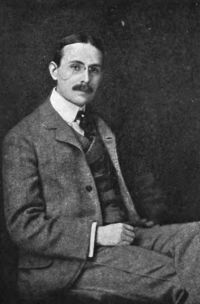
Ralph Henry Barbour

Ralph Henry Barbour

Summary

Portrait of Ralph Henry Barbour Ralph Henry Barbour The Island of Love (1901)

When we reached the farther side of the island we leaned our arms on the fence and looked down almost on to the roof of Laurel House, nestling far below in a grove of squat oaks. From the out-kitchen a slender spiral of blue smoke rose, and I thought regretfully for a bare moment of Aunt Diana's beaten biscuits. Then I glanced at Doris and forgot aught else. What happier fate could mortal man desire than to be cast away on a desert island with Doris?
Source: Wikisource

Portrait of Ralph Henry Barbour Ralph Henry Barbour The Island of Love (1901)

Doris clapped her hands. I leaped—well, I struggled to my feet. In critical moments I am all energy. In a trice I had collected five twigs, eight dead oak leaves and a handful of dry pine needles; in another moment they were alight and crackling merrily. I lay down again and found that by rolling from side to side and stretching my arms to their fullest extent I could replenish the beacon with a minimum of exertion. The sparks floated upward. I am certain that the light would have been visible as far away as the middle of the surging cornfield. Doris looked approval.
Source: Wikisource

Portrait of Ralph Henry Barbour Ralph Henry Barbour The Island of Love (1901)

But, to tell the truth, Doris, I like being cast away in books. You see there is invariably—at least, almost invariably—a beautiful maiden, with whom you fall deeply in love and eventually marry.”
“That's silly,” said Doris, contemptuously.
“Sometimes,” I continued, regarding her over the glowing tip of my cigarette, in which I tried conscientiously to detect a flavor of salt water, “sometimes it happens that the hero and the heroine are cast away on the desert island together. That is even better, according to my views. There you have the love element right from the start.
Source: Wikisource

Get perspective with Kwize: daily news enlightened by great literature