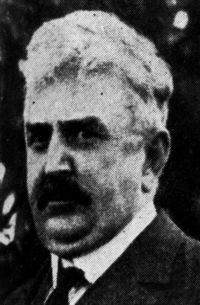
Raymond S. Spears

Raymond S. Spears

Summary

Portrait of Raymond S. Spears Raymond S. Spears The Way of the Mississippi — 5… (1922)

Realism—he should now never lack for the gaunt, livid truth of a man's physical exhaustion, and, he knew, if he ever drew a picture of the Mississippi, it would contain the most careful, exact kind of drawing, but it would also contain the subtlety of atmosphere and the spirit of mystery—no matter how much he would put into any breadth of canvas, or spread of paper, there would lurk in and under and around his subject the shadow that is so much more than substance, the suggestion that is far more than the mere lines and colors.
Source: Wikisource

Portrait of Raymond S. Spears Raymond S. Spears The Way of the Mississippi — 5… (1922)

When a man has won such a decisive victory over himself, he may count on a thousandfold greater strength—perhaps an utter calm—in whatever emergency may arise to try him. He may even go into the inevitable peril that becomes irresistible attack. He may die, but with unflinching steadfastness since he has been prepared for that by an agony of terror, long since met and overcome.
Toskin still felt the brooding menace of the river night; he was wholly conscious of the possibilities of the dark, of the murder shanty boat, of the unseen
Source: Wikisource

Portrait of Raymond S. Spears Raymond S. Spears The Way of the Mississippi — 5… (1922)

Almost unconsciously he sketched that bell in one corner of the cabin, but afterward, looking at it, he knew that if he never made another sketch of the river—that bell showed how much he understood and how far he had come in knowing whereof he longed to speak.
Swinging a canvas hammock across the cabin, Toskin rolled up in a blanket and went sound to sleep. In the morning something awakened him, and opening his eyes, he found himself looking up into the face of the man he had dragged out of the eddy.
Source: Wikisource

Get perspective with Kwize: daily news enlightened by great literature