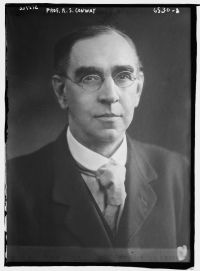
Robert Seymour Conway

Robert Seymour Conway

Summary

Portrait of Robert Seymour Conway Robert Seymour Conway 1911 Encyclopædia Britannica, Volume 10… (1911)

In addition to the remains found in the graves (see Falerii) , which belong mainly to the period of Etruscan domination and give ample evidence of material prosperity and refinement, the earlier strata have yielded more primitive remains from the Italic epoch. A large number of inscriptions consisting mainly of proper names may be regarded as Etruscan rather than Faliscan, and they have been disregarded in the account of the dialect just given.
Source: Wikisource

Portrait of Robert Seymour Conway Robert Seymour Conway 1911 Encyclopædia Britannica, Volume 10… (1911)

It should perhaps be mentioned that there was a town Feronia in Sardinia, named probably after their native goddess by Faliscan settlers, from some of whom we have a votive inscription found at S. Maria di Falleri (Conway, ib. p. 335) .
Further information may be sought from W. Deecke, Die Falisker (a useful but somewhat uncritical collection of the evidence accessible in 1888) ; E. Bormann, in C.I.L. xi. pp. 465 ff., and Conway, op. cit.
Source: Wikisource

Get perspective with Kwize: daily news enlightened by great literature