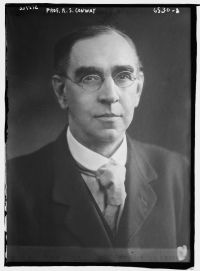
Robert Seymour Conway

Biographical details

Portrait of Robert Seymour Conway Robert Seymour Conway,  The Making of Latin (1923)

“ We ask now, does the suggested derivation accord with the known Phonetic Laws of the language concerned? Or, if it seems to make an exception to any one of them, can the reason for such an exception be found, for instance, in the influence of Analogy? Or, if it involves our recognising a new Phonetic Law, are there any forms which would contradict the new Law and for which no explanation can be found? For example, it was once supposed that the forms of the Latin Passive contained the word sē; amor ‘I am loved’ was derived from “amo sē.” ”
Source: Wikisource

Portrait of Robert Seymour Conway Robert Seymour Conway,  The Making of Latin (1923)

“ To follow the history of the sounds in any language we must understand how sounds are produced.
Just as in a whistle or an organ sound is made by a current of air passing through certain openings, and being set in vibration by certain tongues or edges put in the way of the current, so sound is produced in the human throat and mouth by a current of air sent out from the lungs; and different kinds of sound arise from the different ways in which the current is treated as it passes through the throat and mouth.
”
Source: Wikisource

Portrait of Robert Seymour Conway Robert Seymour Conway,  1911 Encyclopædia Britannica (1911)

“ It is one of the most important problems in ancient history to determine what was the ethnological relation of these tribes, whom we may call "Safine," to the people of Rome on the one hand, and the earlier stratum or strata of population in Italy on the other. Much light has been thrown on this group of questions in recent years both from linguistic and from archaeological sources. For the historical and archaeological evidence which connects the Sabines with the patricians of Rome, see Rome, Ancient History. ”
Source: Wikisource

Get perspective with Kwize: daily news enlightened by great literature