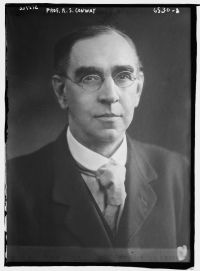
Robert Seymour Conway

Robert Seymour Conway

Summary

Portrait of Robert Seymour Conway Robert Seymour Conway 1911 Encyclopædia Britannica (1911)

It is one of the most important problems in ancient history to determine what was the ethnological relation of these tribes, whom we may call "Safine," to the people of Rome on the one hand, and the earlier stratum or strata of population in Italy on the other. Much light has been thrown on this group of questions in recent years both from linguistic and from archaeological sources. For the historical and archaeological evidence which connects the Sabines with the patricians of Rome, see Rome, Ancient History.
Source: Wikisource

Portrait of Robert Seymour Conway Robert Seymour Conway 1911 Encyclopædia Britannica (1911)

IOVILAE, or Jovilae, a latinized form of iůvilas, the name given by the Oscan-speaking Campanians in the 5th, 4th and 3rd centuries B.C. to an interesting class of monuments, not yet fully understood. They all bear crests or heraldic emblems proper to some family or group of families, and inscriptions directing the annual performance of certain ceremonies on fixed days. While some of them are dedicated to Jupiter (in a special capacity, which our present knowledge of Oscan is insufficient to determine) , others were certainly found attached to graves.
Source: Wikisource

Portrait of Robert Seymour Conway Robert Seymour Conway 1911 Encyclopædia Britannica (1911)

SAMNITES, the name given by the Romans to the warlike tribes inhabiting the mountainous centre of the S. half of Italy. The word Samnites was not the name, so far as we know, used by the Samnites themselves, which would seem rather to have been (the Oscan form of) the word which in Latin appears as Sabini (see below) . The ending of Samnites seems to be connected with the name by which they were known to the Greeks' of the Carnpanian coast, which by the time of Polybius had become Σαυνῖται
Source: Wikisource

Get perspective with Kwize: daily news enlightened by great literature