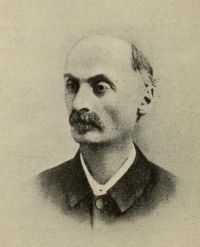
Archibald Henry Sayce

Archibald Henry Sayce

Summary

Portrait of Archibald Henry Sayce Archibald Henry Sayce 1911 Encyclopædia Britannica (1911)

It is obvious, therefore, that grammar constitutes the surest and most important basis for a classification of languages. Words may be borrowed freely by one dialect from another, or, though originally unrelated, may, by the action of phonetic decay, come to assume the same forms, while the limited number of articulate sounds and conceptions out of which language was first developed, and the similarity of the circumstances by which the first speakers were everywhere surrounded, naturally produce a resemblance between the roots of many unconnected tongues.
Source: Wikisource

Portrait of Archibald Henry Sayce Archibald Henry Sayce 1911 Encyclopædia Britannica (1911)

In fact, there is no example of a language which has wholly forsaken the conception of the sentence and the relation of its elements with which it started, although each class of languages occasionally trespasses on the grammatical usages of the others. In language, as elsewhere in nature, there are no sharp lines of division, no sudden leaps; species passes insensibly into species, class into class.
Source: Wikisource

Portrait of Archibald Henry Sayce Archibald Henry Sayce 1911 Encyclopædia Britannica (1911)

We shall thus have a comparative grammar and an historical grammar, the latter being devoted to tracing the history of grammatical forms and usages in the same language. Of course, an historical grammar is only possible where a succession of written records exists; where a language possesses no older literature we must be content with a comparative grammar only, and look to cognate idioms to throw light upon its grammatical peculiarities.
Source: Wikisource

Get perspective with Kwize: daily news enlightened by great literature