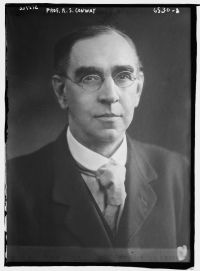
Robert Seymour Conway

Robert Seymour Conway

Summary

Portrait of Robert Seymour Conway Robert Seymour Conway 1911 Encyclopædia Britannica, Volume 18… (1911)

The change of o to a is exceedingly interesting as being a phenomenon associated with the northern branches of Indo-European such as Gothic, Albanian and Lithuanian, and not appearing in any other southern dialect hitherto known. The Greek Ἀφροδίτα appears in the form Aprodita (dat. sing., fem.) . The use of double consonants which has been already pointed out in the Messapian inscriptions has been very acutely connected by Deecke with the tradition that the same practice was introduced at Rome by the poet Ennius who came from the Messapian town Rudiae (Festus, p. 293 M) .
Source: Wikisource

Portrait of Robert Seymour Conway Robert Seymour Conway 1911 Encyclopædia Britannica, Volume 18… (1911)

They are mentioned (Herod. vii. 170) as having inflicted a serious defeat on the Greeks of Tarentum in 473 B.C. Herodotus adds a tradition which links them to the” Cretan subjects of, “King Minos.” (Their language is preserved for us in a scanty group of perhaps fifty inscriptions of which only a few contain more than proper names, and in a few glosses in ancient writers collected by Mommsen (Unteritalische Dialekte, p. 70) . Unluckily very few originals of the inscriptions are now in existence, though some few remain in the museum at Taranto.
Source: Wikisource

Get perspective with Kwize: daily news enlightened by great literature