Summary

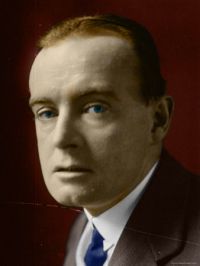
Portrait of Saki Saki Beasts and Super-Beasts — Cousin Teresa (1914)

Cæsar will be an Irish terrier, Fido a black poodle, Jock a fox-terrier, and the borzoi, of course, will be a borzoi. During the third verse Cousin Teresa will come on alone, and the dogs will be drawn across by themselves from the opposite wing; then Cousin Teresa will catch on to the singer and go off-stage in one direction, while the dogs’ procession goes off in the other, crossing en route, which is always very effective. There’ll be a lot of applause there, and for the fourth verse Cousin Teresa will come on in sables and the dogs will all have coats on.
Source: Wikisource

Portrait of Saki Saki Beasts and Super-Beasts — Cousin Teresa (1914)

An enterprising and emancipated preacher discoursed from his pulpit on the inner meaning of “Cousin Teresa,” and Lucas Harrowcluff was invited to lecture on the subject of his great achievement to members of the Young Mens’ Endeavour League, the Nine Arts Club, and other learned and willing-to-learn bodies. In Society it seemed to be the one thing people really cared to talk about
Source: Wikisource

Portrait of Saki Saki Beasts and Super-Beasts — Cousin Teresa (1914)

That is why one welcomes an intelligible production like ‘Cousin Teresa,’ that has a genuine message for one. One can’t understand the message all at once, of course, but one felt from the very first that it was there. I’ve been to see it eighteen times and I’m going again to-morrow and on Thursday. One can’t see it often enough.”
“It would be rather a popular move if we gave this Harrowcluff person a knighthood or something of the sort,” said the Minister reflectively.
“Which Harrowcluff?” asked his secretary.
“Which? There is only one, isn’t there?” said the Minister
Source: Wikisource

Get perspective with Kwize: daily news enlightened by great literature