Summary

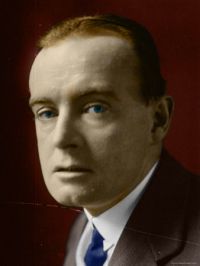
Portrait of Saki Saki The Toys of Peace and Other Papers… (1919)

And probably the majority of human sheep see themselves in imagination taking great parts in the world’s more impressive dramas, forming swift, unerring decisions in moments of crisis, cowing mutinies, allaying panics, brave, strong, simple, but, in spite of their natural modesty, always slightly spectacular.
“Why in the name of all that is unnecessary and perverse should Kathleen choose this man for her future husband?” was the question that Rupert asked himself ruefully.
Source: Wikisource

Portrait of Saki Saki The Toys of Peace and Other Papers… (1919)

If it had been merely Kathleen’s own affair Rupert would have shrugged his shoulders and philosophically hoped that she might make the best of an undeniably bad bargain. But Rupert had no heir; his own boy lay underground somewhere on the Indian frontier, in goodly company. And the property would pass in due curse to Kathleen and Kathleen’s husband. The Sheep would live there in the beloved old home, rearing up other little Sheep, fatuous and rabbit-faced and self-satisfied like himself, to dwell in the land and possess it.
Source: Wikisource

Portrait of Saki Saki The Toys of Peace and Other Papers… (1919)

I’m awfully sorry,” said the Sheep.
Being awfully and uselessly sorry formed a large part of his occupation in life. If a similar situation had arisen in a subsequent hand he would have blundered just as certainly, and he would have been just as irritatingly apologetic.
Rupert stared gloomily across at him as he sat smiling and fumbling with his cards. Many men who have good brains for business do not possess the rudiments of a card-brain, and Rupert would not have judged and condemned his prospective brother-in-law on the evidence of his bridge play alone.
Source: Wikisource

Get perspective with Kwize: daily news enlightened by great literature