Summary

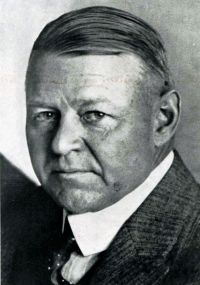
Portrait of Samuel Hopkins Adams Samuel Hopkins Adams The Secret of Lonesome Cove — Chapter V. One Use For A Monocle (1912)

But Sedgwick, whose eyes had been fixed upon Kent, saw a curious expression flicker and fade across the long-jawed face. It was exactly the expression of a dog that pricks up its ears. The next moment a titter ran through the crowd as a bumpkin in a rear seat called out:
“The dude’s eyes ain’t mates!”
Chester Kent, already conspicuous in his spotless white flannels, had made himself doubly so by drawing out a monocle and deftly fixing it in his right eye. He leaned over the body to look into the face, and his head jerked back the merest trifle.
Source: Wikisource

Portrait of Samuel Hopkins Adams Samuel Hopkins Adams The Secret of Lonesome Cove — Chapter V. One Use For A Monocle (1912)

Others took up the cry. Clamor rose and spread in the room. The sheriff silenced it with a stentorian voice. “What are you trying to get at?” he demanded, facing Kent.
“The truth. What are you?”
Schlager’s eyelids flickered; but he ignored the counter-stroke. “Look out it don’t lead you where you won’t want to follow,” he returned, with a significant look at Sedgwick.
“This is as far as it has led me,” said Kent, in his clear even voice. “The body, already dead, was dragged down and soaked in the sea, and then lashed to the grating by a man who probably is or has been a sailor.”
Source: Wikisource

Portrait of Samuel Hopkins Adams Samuel Hopkins Adams The Secret of Lonesome Cove — Chapter V. One Use For A Monocle (1912)

Chancing to look down at it, Sedgwick started and stared. Kent’s knuckle, as seen through the glass, stood forth, monstrous and distorted, every line of the bronzed skin showing like a furrow.
The monocle was a powerful magnifying lens.
The sheriff’s heavy voice rose. “Any one here present recognize or identify the deceased?” he droned, and, without waiting for a reply, set the lid in place and signaled to the medical officer.
“Feller citizens,” began the still shaking physician, “we don’t need any jury to find that this unknown drowned woman—”
“The deceased was not drowned.”
Source: Wikisource

Get perspective with Kwize: daily news enlightened by great literature