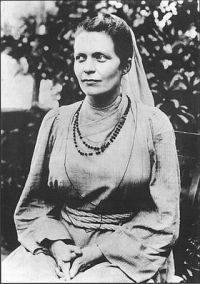
Sister Nivedita

Sister Nivedita

Summary

Portrait of Sister Nivedita Sister Nivedita An Indian Study of Love and Death (1908)

Those waiting at the burning-ghât to offer the last rites, can judge by the nearing sound of the singing how long or how short will be the time before the mourners—bareheaded, barefooted, and clad in white—arrive. But in the whole of Hindu music, there is neither death-croon, nor dirge, nor sad eternal lullaby. The chanting here is all of prayers, and psalms, and hymns. To Hindu thinking, there is in fact no death, and as simple folk are carried to the burning-ghât the bearers cry only by the road, “Nama Rama sattya hai!”
Source: Wikisource

Portrait of Sister Nivedita Sister Nivedita An Indian Study of Love and Death (1908)

Supreme Love, that manifestest Thyself in Thy power, and passion is burnt to ashes.
Wondrous Equanimity, Foundation-stone of holiness,
To Thee our salutation.
Thee we salute. Thee we salute.
Thee we salute.
Thou Tempest of the freedom of the soul!
Wind of the spiritual mountains,
Insatiable longing for self-sacrifice,
Realisation of our self as all,
Love for the sake of love,
Work for the work’s own sake,
Renunciation without an object,
To Thee our salutation.
Source: Wikisource

Portrait of Sister Nivedita Sister Nivedita An Indian Study of Love and Death (1908)

May the Heaven-Father cover us with benediction!
Full of blessing be the great trees,
And full of blessedness the sun!
May our herds of cattle be sanctified to us!”
Thus, on each of its children, wearied of sadness, does the Eternal Faith put forth the soothing hand of its own great wisdom and love. Indulging in no perversity of isolation is the soul called to fare forth into the great world, and tread there, manfully, the allotted path. Yet memory is not forbidden. Tender prayer has its own place.
Source: Wikisource

Get perspective with Kwize: daily news enlightened by great literature