Summary

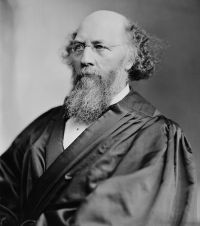
Portrait of Stephen Johnson Field Stephen Johnson Field Stickney v. Stickney — Opinion of the Court

The general rule of the common law is that neither husband nor wife is admissible as a witness for or against each other in any case, civil or criminal. This exclusion, as Greenleaf says, is founded partly upon the identity of their legal rights and interests, and partly on principles of public policy, that the confidence existing between them shall be sacredly protected and cherished to the utmost extent, as being essential to the happiness of social life.
Source: Wikisource

Portrait of Stephen Johnson Field Stephen Johnson Field Stickney v. Stickney — Opinion of the Court

If there be no proof of indebtedness to the party receiving the moneys, the presumption would naturally be that they were placed with him to be held subject to the order of the other party, or to be invested for the latter's benefit. We think that whenever a husband acquires possession of the separate property of his wife, whether with or without her consent, he must be deemed to hold it in trust for her benefit, in the absence of any direct evidence that she intended to make a gift of it to him.
Source: Wikisource

Portrait of Stephen Johnson Field Stephen Johnson Field Stickney v. Stickney — Opinion of the Court

In such a case it lies upon one who asserts it to be the property of the husband to prove a transmission of the title, either by gift or contract for value, for the law does not transmit it without the act of the parties. If mere possession were sufficient evidence of a gift, the act of 1848 would be useless to the wife. Nothing is more easy than for the husband to obtain possession, even against the consent of the wife
Source: Wikisource

Get perspective with Kwize: daily news enlightened by great literature