Theodor Nöldeke

Theodor Nöldeke

Summary

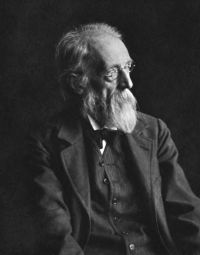
Portrait of Theodor Nöldeke Theodor Nöldeke 1911 Encyclopædia Britannica (1911)

It is a phenomenon which deserves the fullest recognition, that the needy inhabitants of a barren country should thus have produced an artistic poetry distinguished by so high a degree of uniformity. Even the extraordinary strict metrical system, observed by poets who had no inkling of theory and no knowledge of an alphabet, excites surprise. In the most ancient poems the metrical form is as scrupulously regarded as in later compositions. The only poem which shows unusual metrical freedom is the above-mentioned song of ‛Abīd.
Source: Wikisource

Portrait of Theodor Nöldeke Theodor Nöldeke 1911 Encyclopædia Britannica (1911)

In the Mo‛allaqāt of ‛Amr and Ḥārith, for the preservation of which we are especially grateful to the compiler, we can read the haughty spirit of the powerful chieftains, boastfully celebrating the splendours of their tribe. These two poems have also a certain historical importance. The song of Zuhair contains the practical wisdom of a sober man of the world. The other poems are fairly typical examples of the customary qaṣīda, the long poem of ancient Arabia, and bring before us the various phases of Bedouin life.
Source: Wikisource

Portrait of Theodor Nöldeke Theodor Nöldeke 1911 Encyclopædia Britannica (1911)

In the Mo‛allaqa of Ṭarafa we are repelled by the long, anatomically exact description of his camel; but such a description had an extraordinary charm of its own for the Bedouins, every man of whom was a perfect connoisseur on this subject down to the minutest points; and the remaining parts of the poem, together with the other extant fragments of his songs, show that Ṭarafa had a real poetic gift.
Source: Wikisource

Get perspective with Kwize: daily news enlightened by great literature