Summary

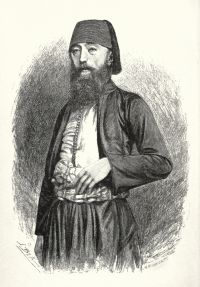
Portrait of Edward Henry Palmer Edward Henry Palmer 1911 Encyclopædia Britannica, Volume 10… (1911)

Firdousī’s own education eminently qualified him for the gigantic task which he subsequently undertook, for he was profoundly versed in the Arabic language and literature and had also studied deeply the Pahlavi or Old Persian, and was conversant with the ancient historical records which existed in that tongue.
The Shāhnāma of Firdousī (see also Persia: Literature) is perhaps the only example of a poem produced by a single author which at once took its place as the national epic of the people.
Source: Wikisource

Portrait of Edward Henry Palmer Edward Henry Palmer 1911 Encyclopædia Britannica, Volume 10… (1911)

Mahmud now definitely selected him for the work of compiling and versifying the ancient legends, and bestowed upon him such marks of his favour and munificence as to elicit from the poet an enthusiastic panegyric, which is inserted in the preface of the Shāhnāma, and forms a curious contrast to the bitter satire which he subsequently prefixed to the book. The sultan ordered his treasurer, Khojah Hasan Maimandi, to pay to Firdousī a thousand gold pieces for every thousand verses
Source: Wikisource

Portrait of Edward Henry Palmer Edward Henry Palmer 1911 Encyclopædia Britannica, Volume 10… (1911)

Mahmūd ibn Sabuktagin, the second of the dynasty (998–1030) , continued to make himself still more independent of the caliphate than his predecessors, and, though a warrior and a fanatical Moslem, extended a generous patronage to Persian literature and learning, and even developed it at the expense of the Arabic institutions. The task of continuing and completing the collection of the ancient historical traditions of the empire especially attracted him.
Source: Wikisource

Get perspective with Kwize: daily news enlightened by great literature