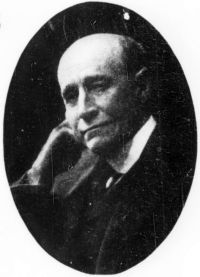
W. A. Fraser

W. A. Fraser

Summary

Portrait of W. A. Fraser W. A. Fraser The Stolen Kasaba (1906)

Runfeet answered, "and here is his purse with ten rupees that the Sahib has lost in my gharry."
There was the clink of a chain, the rasp of a bolt, the creak of hinges as the heavy gate was swung to a crack; a lean black arm was thrust through, and a voice said: "Give me the purse, brother—I will give it to the Sahib."
"Call the Sahib," Runjeet answered, "that I may give it into his hands. How do I know that thou are not a thief?—all durwans are of the robber caste," and he jingled the rupees seductively in his hand.
Source: Wikisource

Portrait of W. A. Fraser W. A. Fraser The Stolen Kasaba (1906)

The "Bushira," the most beautiful pearl in the world, that had just come up from its finding in the Persian Gulf, was to be enthroned in this wonderful golden crown, surrounded by myriads of lesser pearls.
Hansen, the head clerk, had in charge this trinket that would cost four lakhs of rupees—$1,25,000. All day he must keep his eyes on the priceless pearls, and at midnight take them to the vault in the showroom, of which he and the manager alone knew the combination.
Source: Wikisource

Portrait of W. A. Fraser W. A. Fraser The Stolen Kasaba (1906)

And having money, first of all he'll want a drink, so he'll drive to the Esplanade, where all good sailors drink. So if you're to hunt with me to-night, Chief, you can post yourself at the Esplanade corner at six. We'll need a determined man or two if we run Holborn to earth; he's a bad one."
As Teck had foretold, about half-past six the pock-marked sailor who was Straddles came to the landing ghat opposite the "Carnatic." There was no gharry stand at that point, and Straddles eagerly engaged the one he found casually waiting.
Source: Wikisource

Get perspective with Kwize: daily news enlightened by great literature