Summary

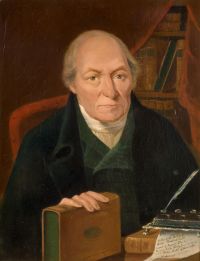
Portrait of William Hutton William Hutton The History of the Roman Wall/Part 2… (1802)

The bottom, which is from one to three miles over, is the height of rural beauty, extending to the verge of the Lake, and consisting of woods, fertile meadows, and gentlemen's seats. In this centre lies the charming Lake, whose surface was as smooth, pleasant, and clear, as a looking glass, with a smiling face before it. Not a breath of air to cause a wrinkle, but a bright sun illuminated the view. If an assemblage of mountains, romantic rocks, extensive prospects, fertile vallies, ornamental woods, elegant seats, with a grand expanse of water, can compleat a landscape, it may be found here.
Source: Wikisource

Portrait of William Hutton William Hutton The History of the Roman Wall/Part 2… (1802)

ELEVEN miles, has about eleven streets, eight hundred houses, of stone, and nine thousand and thirty inhabitants; is a genteel place, and abounds with elegant buildings; but the streets are narrow, according to the old fashion of street-making. Our ancestors built for themselves, they never thought of posterity. The Castle, which is in good repair, carries the face of antient grandeur. This, and the great church, are together, and on a high hill, which commands an extensive and beautiful view. I saw the foundation of Wery Wall, a Roman work, which seems to have surrounded the Castle-hill.
Source: Wikisource

Portrait of William Hutton William Hutton The History of the Roman Wall/Part 2… (1802)

Every tide changes their face, and leaves hills and vallies. Whatever marks of feet, or wheels, are left in the vacancy of one tide, are washed out by the next. Nor has the stranger any object before him for a guide, because his journey is curved like a bow. A few bushes are pricked into the sands to direct the traveller; but they are small, and the line is often broken, The spring-tides rise about nineteen feet.
Source: Wikisource

Get perspective with Kwize: daily news enlightened by great literature