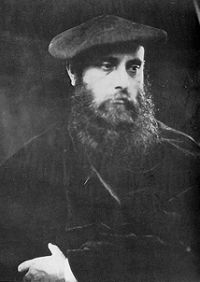
William Michael Rossetti

William Michael Rossetti

Summary

Portrait of William Michael Rossetti William Michael Rossetti 1911 Encyclopædia Britannica, Volume 26… (1911)

Something that one could see—that is his ideal, not something that one could narrate, still less that one could deduce and demonstrate. In his treatment of action or gesture the most constant peculiarity is the sway and swerve of his figures: they bend like saplings or rock like forest-boughs in a gale; stiffness or immobility was entirely foreign to his style, which has therefore little of the monumental or severe character. Perhaps he felt that there was no other way for combining “the colour of Titian with the design of Michelangelo.”
Source: Wikisource

Portrait of William Michael Rossetti William Michael Rossetti 1911 Encyclopædia Britannica, Volume 26… (1911)

The eyes are large, dark and round; the grizzled hair close and compact. The face has been held to bear some resemblance to that of Michelangelo, but this does not go very far. Robusti appears also as one of the figures in the two vast pictures by Paul Veronese—the “Marriage in Cana” and the “Feast in the House of Levi.”
Audacious and intrepid, though not constantly correct, as a draughtsman, majestically great as a colourist, prodigious as an executant, Tintoret was as absolute a type of the born painter as the history of art registers or enables us to conceive.
Source: Wikisource

Portrait of William Michael Rossetti William Michael Rossetti 1911 Encyclopædia Britannica, Volume 26… (1911)

TINTORETTO, JACOPO ROBUSTI (1518–1594) , one of the greatest painters of the Venetian school, was born in Venice in 1518, though most accounts say in 1512. His father, Battista Robusti, was a dyer, or “tintore”; hence the son got the nickname of “Tintoretto,” little dyer, or dyer’s boy, which is Englished as Tintoret. In childhood jacopo, a born painter, began daubing on the dyer’s walls; his father, noticing his bent, took him round, still in boyhood, to the studio of Titian, to see how far he could be trained as an artist.
Source: Wikisource

Get perspective with Kwize: daily news enlightened by great literature