Summary

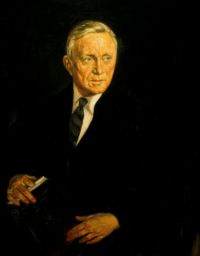
Portrait of William O. Douglas William O. Douglas Transcontinental Western Air v…

A uniform rate forces carriers within a given class to compete in securing revenue and in reducing or controlling costs. If the Board had authority on the basis of the carrier's needs to make rates retroactive to any point of time, there would be a powerful incentive to seek relief from the uniform rate, not to live within it.
Source: Wikisource

Portrait of William O. Douglas William O. Douglas Transcontinental Western Air v…

The language of § 406 (a) which empowers the Board to 'fix and determine' after notice and hearing 'the fair and reasonable rates of compensation' for the transportation of mail by aircraft [3] reads like a typical public utility rate-making authority. Both subdivisions (a) and (b) of § 406, to be sure, reflect some characteristics of ratemaking which are peculiar to air carriers.
Source: Wikisource

Portrait of William O. Douglas William O. Douglas Transcontinental Western Air v…

Petitioner's reading of the Act would in practical effect have the tendency to transform it into a cost-plus system of regulation, a construction which would not harmonize with the apparent design of the Act. Thus § 406 (b) authorizes the Board to fix rates for 'classes of air carriers.' [7] It is plain that the uniform rate for the class is an important regulatory device. For § 2 (d) of the Act looks to the sound development of an air transportation system through competition.
Source: Wikisource

Get perspective with Kwize: daily news enlightened by great literature