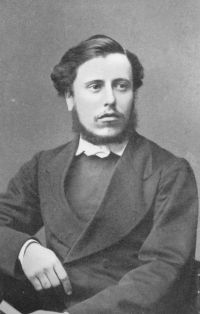
William Robertson Smith

William Robertson Smith

Summary

Portrait of William Robertson Smith William Robertson Smith 1911 Encyclopædia Britannica (1911)

On the other hand, there is some evidence that a system of value by position was known to Sanskrit writers on arithmetic in the 6th Christian century. These writers, however, do not use ciphers, but symbolical words and letters, so that it is not quite clear whether they refer to a system which had a zero, or to a system worked on an abacus, where the zero is represented by a blank column. There is no proof as yet for the use of any system of position in India before the 6th century, and nothing beyond conjecture can be offered as to its origin.
Source: Wikisource

Portrait of William Robertson Smith William Robertson Smith 1911 Encyclopædia Britannica (1911)

The use of visible signs to represent numbers and aid reckoning is not only older than writing, but older than the development of numerical language on the denary system; we count by tens because our ancestors counted on their fingers and named numbers accordingly. So used, the fingers are really numerals, that is, visible numerical signs; and in antiquity the practice of counting by these natural signs prevailed in all classes of society. In the later times of antiquity the finger symbols were developed into a system capable of expressing all numbers below 10,000.
Source: Wikisource

Portrait of William Robertson Smith William Robertson Smith 1911 Encyclopædia Britannica (1911)

In Europe, before the introduction of the algorithm or full Indo-Arabic system with the zero, we find a transition system in which calculations were made on the decimal system with an abacus, but instead of unit counters there were placed in the columns ciphers, with values from one to nine, and of forms that are at bottom the Indian forms and agree most nearly with the numerals used by the Arabs of Africa and Spain.
Source: Wikisource

Get perspective with Kwize: daily news enlightened by great literature