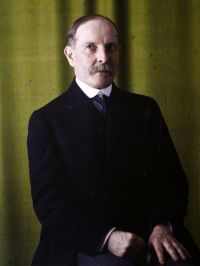
Arthur Edwin Kennelly

Arthur Edwin Kennelly

Summary

Portrait of Arthur Edwin Kennelly Arthur Edwin Kennelly Popular Science Monthly (1904)

Most persons grant that the metric system is superior for practical as well as scientific purposes to the British system, but dread the cost of a change or transition. There can be no doubt that the question of expense of transition is a serious one. In fact, if the only alternatives were the immediate compulsory adoption of the metric system on the one hand, to the extent of throwing away every existing measure and standard, or never adopting the metric system, on the other hand, it is probable that the latter alternative would be necessary
Source: Wikisource

Portrait of Arthur Edwin Kennelly Arthur Edwin Kennelly Popular Science Monthly (1904)

If an attempt were made deliberately to construct a medley of weight and measures as a burlesque, for sensible practical people to make sport of, it may be questioned whether such a farcical hypothetical medley would be more illogical, incoherent or cumbersome than our own. Yet it would seem that ours is not worse than the old French, or German, or Austrian, systems that preceded the metric system in those countries, respectively.
Source: Wikisource

Portrait of Arthur Edwin Kennelly Arthur Edwin Kennelly Popular Science Monthly (1904)

IN this age the knowledge of arithmetic is so widespread that it is difficult to conceive that it is comparatively young. The three R's, Reading, 'Riting and 'Rithmetic, seems to our mind almost axiomatic and fundamental in regard to education. It is, therefore, very interesting to read in histories of arithmetic that the earliest known book which contains a systematic exposition of the decimal system of numeration was written in the seventh century, and that our familiar arabic numerals 1, 2, 3, 4, 5, 6, 7, 8, 9, can not be traced to an earlier century than the seventh.
Source: Wikisource

Get perspective with Kwize: daily news enlightened by great literature