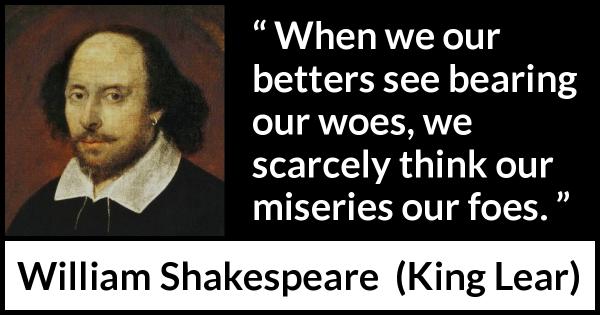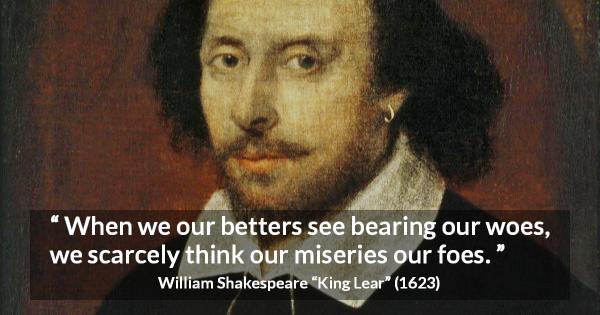


“ When we our betters see bearing our woes, we scarcely think our miseries our foes. ”
William Shakespeare, King Lear (1623). copy citation
| Author | William Shakespeare |
|---|---|
| Source | King Lear |
| Topic | grief empathy pain |
| Date | 1623 |
| Language | English |
| Reference | |
| Note | Written between 1603 and 1606 |
| Weblink | http://www.gutenberg.org/cache/epub/1128/pg1128-images.html |
Context
“Stand in hard cure. [To the Fool] Come, help to bear thy
MASTER. Thou must not stay behind. Glou. Come, come, away!
Exeunt [all but Edgar]. Edg. When we our betters see bearing our woes,
We scarcely think our miseries our foes. Who alone suffers suffers most i' th' mind, Leaving free things and happy shows behind; But then the mind much sufferance doth o'erskip When grief hath mates, and bearing fellowship.” source
MASTER. Thou must not stay behind. Glou. Come, come, away!
Exeunt [all but Edgar]. Edg. When we our betters see bearing our woes,
We scarcely think our miseries our foes. Who alone suffers suffers most i' th' mind, Leaving free things and happy shows behind; But then the mind much sufferance doth o'erskip When grief hath mates, and bearing fellowship.” source
Meaning and analysis