AI-generated from sources
The Allure of the Arduous Path, Cycling's Journey from Utility to Endurance
In Brief
- Early cycling was promoted as effortless leisure, but the rugged realities of 19th-century American roads often transformed rides into demanding physical ordeals.
- Challenging terrains like loose sand, thick mud, and steep hills frequently rendered the bicycle a cumbersome burden, forcing riders to push or carry it.
- A philosophical shift in Western culture redefined meaningful leisure from passive rest to active, internally motivated pursuits that strengthened the mind and body.
- This evolving perspective allowed cyclists to find profound value and satisfaction in the very struggles of arduous journeys, embracing difficulty as the highest form of recreation.
Main authors

The contemporary image of cycling is increasingly defined by a deliberate pursuit of difficulty. From the surge in gravel biking on unpaved service roads to ultra-endurance races across continents, a significant segment of the cycling world now equates the value of a ride with the magnitude of the challenge it presents. This modern ethos, which celebrates grit, resilience, and a connection with rugged landscapes, stands in stark contrast to the bicycle's original promise in the late 19th century. Initially heralded as a revolutionary machine for efficient transport and pleasant leisure, the bicycle was envisioned as a means to glide effortlessly through a tamed, civilized world, making the joy of movement accessible and distinct from the rigors of labor.
This foundational ideal of effortless mobility, however, quickly collided with the physical realities of the era. Promoters of cycling tourism imagined journeys of fun and health on well-maintained roads, explicitly cautioning against turning recreation into arduous work [1]. The successful tour was predicated on a supportive infrastructure of reliable maps and accessible repair shops, which were becoming more available [2]. Yet, this vision was consistently undermined by the untamed nature of the landscape itself. For many early riders, especially in America, roads were frequently rugged, sandy, or steep, transforming the promise of a pleasant excursion into a demanding physical ordeal that challenged the very utility of the machine [3, 4]. This tension between the dream of frictionless travel and the reality of a resistant environment set the stage for a profound evolution in cycling's cultural purpose.
An Ideal of Civilized Mobility
In its nascent years, the bicycle was framed as an instrument of moderate and enjoyable recreation. The prevailing wisdom, as disseminated in popular journals of the 1890s, was that the point of a cycling trip was amusement and health . Riders were advised to avoid overexertion, such as tackling “absurdly steep hills” or attempting to match professional speeds, lest the activity cross the line from pleasurable leisure into exhausting work . This perspective established a clear boundary: the bicycle was meant to enhance life by providing invigorating exercise, not by demanding excessive physical sacrifice. The ideal cyclist was one who found a happy medium, enjoying the ride without succumbing to the fatigue of a demanding task.
The realization of this ideal was heavily dependent on the quality of the physical environment. Proponents of bicycle touring noted that while logistical support like road-books and repair shops was improving in the United States, American roads remained inferior to their European counterparts . This single disadvantage was significant, as the entire concept of a pleasant, multi-day tour rested on the existence of consistently good surfaces. The bicycle, a machine of efficiency, could only deliver on its promise within a landscape that had been sufficiently tamed and ordered for its use. The primary difficulties for the American cyclist, therefore, stemmed not from the machine itself but from the unpredictable and often-unforgiving terrain it had to traverse .
Even in regions with established road networks, the natural world presented formidable obstacles that defied the ideal of smooth travel. A stretch of loose sand could instantly rob a cyclist of all momentum, demanding immense effort to make any progress at all . Similarly, hills were a constant source of difficulty, with some inclines being so steep and treacherous that they were considered functionally impassable for any cyclist, regardless of skill . In these moments, the bicycle ceased to be a tool for effortless movement and became a cumbersome object to be pushed or navigated around, forcing riders to confront the stark limitations of their machine when faced with an untamed topography.
When the Machine Becomes a Burden
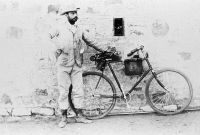
Venturing beyond maintained roads plunged early cyclists into environments where the struggle for progress became the dominant experience. Accounts from pioneers crossing vast, undeveloped territories reveal a constant battle against the elements. On desert trails, the path could become indistinguishable from the surrounding sand and gravel, forcing riders to navigate by sparse stone markers while the terrain alternated between rideable sections and unmanageably heavy sand [5, 7]. In these settings, the bicycle's utility was intermittent at best, and the rider's journey was often reduced to a laborious, ankle-deep wade through an endless expanse of loose earth . The machine designed for speed became an anchor in a hostile landscape.
The physical ordeal was not limited to sand. Cyclists encountered a vast array of challenging surfaces, from the sharp, loose grit and jutting boulders of desert trails to the thick, clinging mud of loamy soils after a rain [6, 9]. Navigating these surfaces often made pedaling impossible, forcing a grim inversion of the human-machine relationship. Instead of being carried by the bicycle, the rider was compelled to carry it, or at least to trundle alongside it, scraper in hand, through the worst patches [11]. This act of “hike-a-bike,” a necessity when crossing stony creeks or navigating deeply rutted tracks, transformed the journey into a slow, tiring walk where the bicycle was little more than dead weight [12, 13].
The challenges were not merely underfoot. The broader environment posed its own dangers, from narrow mountain trails clinging to rock faces where a single slip could be fatal [8] to the semi-darkness of navigating miles of railway snow-sheds [10]. The psychological toll of such journeys was immense. In the desert, losing the track or suffering a mechanical failure could be a death sentence, a reality underscored by the presence of solitary graves along the route . The bicycle, in these extreme contexts, became a liability, a burdensome possession that a desperate, dehydrated traveler might abandon in a last-ditch search for water .
Redefining Recreation, The Virtue of the Struggle
The frequent and intense hardships faced by early cyclists coincided with a broader philosophical reconsideration of leisure in Western culture. Thinkers began to challenge the idea that recreation was synonymous with passive rest [18]. Instead, a new ideal emerged that defined meaningful leisure as an active, internally motivated pursuit that strengthened underused faculties of mind and body [20, 22]. Idleness was increasingly viewed as a source of boredom and decay, while the completion of hard work was seen as the necessary precondition for enjoying true repose [19, 21]. This intellectual shift created a framework in which difficult, voluntary exertion could be understood not as a chore, but as the highest form of leisure.
This new perspective provided a way to find profound value in the very struggles that cycling often entailed. Pursuits like cycling and rock-climbing came to be appreciated for offering a sharp contrast to the routines of daily life, providing a direct engagement with the “bare realities” of humanity's struggle with nature [14]. The initial misery of a grueling ride through precipitous country could be transformed, in retrospect, into a source of immense satisfaction and delight once the journey was complete and the rider was resting with a well-earned appetite [15]. This mindset allowed for an embrace of difficulty, enabling cyclists to find a strange pleasure in navigating even the roughest, most jarring stone tracks [16]. The monotonous security of a straight, easy road was even seen by some as irksome compared to the engaging twists and turns of a more challenging path [17].
The psychological effects of navigating difficult terrain became part of its appeal. The need to constantly scan and react to obstacles on an irregular road could induce a state of irresistible fascination and intense mental focus, fully absorbing the rider's attention [23]. The dynamic of intermittent exertion followed by rewarding release—such as the effort of dragging a bicycle up a hill for the
The cultural trajectory of the bicycle reveals a remarkable evolution, from a symbol of effortless modernity to a tool for embracing deliberate hardship. Conceived in the late 19th century as a means for pleasant, healthy leisure on civilized roads , its practical application was immediately complicated by the rugged realities of the physical landscape . The frequent transformation of the bicycle from a vehicle of transport into a burdensome load forced a confrontation with the limits of the machine and the will of the rider . Yet, rather than deterring participation, this struggle became the foundation for a new ethos. Drawing on emerging philosophies of active leisure, the cycling world began to redefine recreation not as the avoidance of work, but as the voluntary pursuit of meaningful challenges [24].
This historical shift provides the essential context for understanding the motivations behind contemporary endurance sports and adventure cycling. The modern gravel rider or bikepacker who actively seeks out remote trails and difficult conditions is the direct heir to a tradition that learned to value the journey for its trials, not merely its destination. The persistent allure of the arduous path demonstrates a deep-seated desire to test one's own limits and to forge a more profound connection with the natural world. In doing so, the bicycle's purpose has come full circle—not as a machine to insulate its rider from the environment, but as a simple, elegant tool to engage with it more completely.