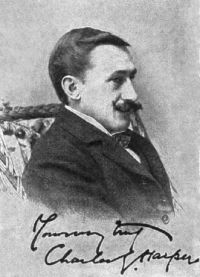
Charles G. Harper

Biographical details

Portrait of Charles G. Harper Charles G. Harper The Ingoldsby Country: Literary Landmarks of the "Ingoldsby Legends"

The valley opens wide, and on either side of it climb gently-rising hills clothed with thin woods, the Folkestone Road ascending the shoulder of the hills to the left. From it we look down upon a beautiful flat expanse of meadow-land; but no lodge-gate, no stone lions, no avenue, and certainly not the slightest trace of a park nor of a grand manor house can be seen. Only an old farmstead, half-smothered in ivy and creepers, is seen, in midst of the open meadow. It is a dream of rustic beauty, but—it is not the manor house of Barham's vivid fancy and picturesque pen.
Source: Gutenberg

Portrait of Charles G. Harper Charles G. Harper The Cornish Coast (South), and the Isles of Scilly

The lovely valley is seen in a romantic perspective from the summit of the lofty hill that leads up to Calstock church, for from that point of view you look down upon the little peninsular meadows that now and again give place to cliffs, and through an atmosphere of silver and gold see the river winding past them, like some Pactolian stream. Down there lie the ruins of Harewood House, the old Duchy of Cornwall office; across, as far as eye can reach, spread the blue distances of Devon, and all along the course of the river the hamlets are transfigured to an unutterable beauty.
Source: Gutenberg

Portrait of Charles G. Harper Charles G. Harper The South Devon Coast

A short distance brings the explorer to a sight of the sea again, glimpsed between the stone arches of a railway-bridge spanning a tiny cove or inlet. A walk through the arches on to the sands, if the tide be out, or the ascent of a dozen steps up to the sea-wall, if it be in, brings the stranger into the best and easiest, and certainly, into the most beautiful, approach to Teignmouth, by the sea the whole way and under the shadow of the tremendous red cliffs, at whose foot the railway, by the daring of Brunel, is made to run along the most massive of sea-walls.
Source: Gutenberg

Get perspective with Kwize: daily news enlightened by great literature