Summary

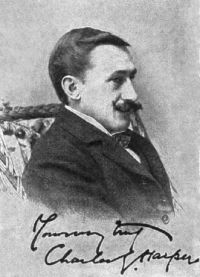
Portrait of Charles G. Harper Charles G. Harper The Holyhead Road: The Mail-coach Road to Dublin…

It is a relic of Old England of the days before railways: no museum specimen, but an open-air survival, unnoted and untravelled; discovered by the few who, haply realising what it is, thread its winding course and leave the modern well worn road to the crowd.
Descending Ridge Hill, into the valley of the Colne, London Colney is reached, skirting the road by that insignificant stream, spanned by a picturesque old red-brick bridge, whose generous proportions seem to be much too large for so unassuming a runlet.
Source: Gutenberg

Portrait of Charles G. Harper Charles G. Harper The Holyhead Road: The Mail-coach Road to Dublin…

The everyday aspect of the barracks is not inspiring. Only occasionally, when on the neighbouring hillsides a sabre-scabbard flashes by chance in the sun, and the eye thus startled discovers some leisurely horseman scouting, visible to all the world, is the military view of Weedon productive of a thrill.
Many soldiers lie in the crowded churchyard round the ugly church, jammed in an angle between railway and canal: the trains rushing by on a lofty viaduct that looks down upon the damp, sunless and melancholy wedge of land.
Source: Gutenberg

Portrait of Charles G. Harper Charles G. Harper The Holyhead Road: The Mail-coach Road to Dublin…

Passing it, bid a long farewell, O traveller along the Holyhead Road, to the country, for in less than another two miles Wells Green is reached and Birmingham within hail. Thereafter, in nothing less than eighteen miles shall you see the hedgerows, the fields, and the quiet road again. Birmingham and the Black Country intervene, and not until, having gained and overpassed Wolverhampton, you ascend the heights of Tettenhall, will the sun be seen shining in a clear sky once more.
Source: Gutenberg

Get perspective with Kwize: daily news enlightened by great literature