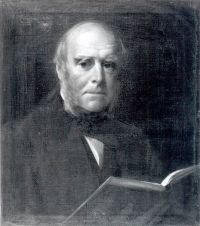
William Bodham Donne

William Bodham Donne

Summary

Portrait of William Bodham Donne William Bodham Donne Old Roads and New Roads

The highways which conveyed to the warehouses of Carthage the ivory, gold-dust, slaves, and aromatic gums of Central Libya ran through miles of well-ordered gardens and by hundreds of villas; and it was the ruthless destruction of these country-seats of the merchant-princes of Byrsa, which forced upon them the first and the second peace with Rome.
The Grecian roads, like the modern European highways, represented the free genius of the people: they were often sinuous in their course, and, respecting the boundaries of property, wound around the hills rather than disturb the ancient landmarks.
Source: Gutenberg

Portrait of William Bodham Donne William Bodham Donne Old Roads and New Roads

If you look to move through this little volume in a direct line, after the present fashion of Railway Travelling, you will be signally disappointed. Nothing can well be more circuitous than the route proposed to you, nor more eccentric than your present guide. This book aspires to the precision of neither Patterson nor Bradshaw. Let men “bloody with spurring, fiery hot with speed,” consult those oracles of swiftness and rectitude of way: we do not belong to their manor. We desire to beguile, by a sort of serpentine irregularity, the occasional tedium of rapid movement.
Source: Gutenberg

Portrait of William Bodham Donne William Bodham Donne Old Roads and New Roads

Perhaps the very antiquity of roads, and the wide arc of generations comprised in the subject, have deterred competent persons from attempting it; yet therefore is it only the more strange that incompetent persons have not essayed “this great argument,” since they generally rush in, where their betters fear to tread. A history of roads is, in great measure indeed, a history of civilization itself. For highways and great cities not merely presuppose the existence of each other, but are also the issues and exponents of two leading impulses in the nature of man.
Source: Gutenberg

Get perspective with Kwize: daily news enlightened by great literature