Summary

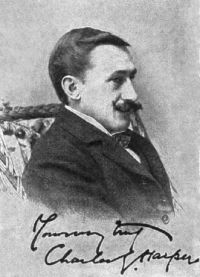
Portrait of Charles G. Harper Charles G. Harper The Manchester and Glasgow Road…

It is interesting, with an interest almost pathetic, to journey on to Manchester and to notice how the urban undertone of the road grows to be the dominant note: how the wayside fringe of bricks and mortar widens and the meadows give place first to brickfields and finally to grey streets. You pass from place to place and think them all one: from Hazel Grove to Heaviley, and thence to Stockport, Heaton Norris, Heaton Chapel, Levenshulme, Grindley Marsh, Longsight, and Ardwick Green, finally coming into Manchester by the infernal din of the thronging traffic at London Road railway station.
Source: Gutenberg

Portrait of Charles G. Harper Charles G. Harper The Manchester and Glasgow Road…

Let no one, charmed with the name of Mountsorrel, come to the place with high expectations of finding a picturesqueness to match. The romantic scenery of rugged rock looking down upon the pleasant valley of the Soar has been since 1845 the scene of quarry operations, and atrocious raw scars seam the mount on all sides; and beneath it, and for close upon a mile along the road, runs an abject townlet of the out-at-elbows, down-at-heel variety, with rows upon rows of mean cottages where many of the seven hundred quarrymen and their families dwell. That is modern Mountsorrel.
Source: Gutenberg

Portrait of Charles G. Harper Charles G. Harper The Manchester and Glasgow Road…

Brailsford, on the way to Ashbourne, still tells in no uncertain way, to those interested in these things, of coaching days. Here still stand the “Rose and Crown,” the “Saracen’s Head,” where the old “Manchester Defiance” changed horses, and a number of farmhouses that were once inns of various grades. And now the scenery grows bold and lovely with thickly wooded hill and dale. Down on the left hand you see a magnificent castellated building of dark limestone, seated in a park where deer are roaming.
Source: Gutenberg

Get perspective with Kwize: daily news enlightened by great literature