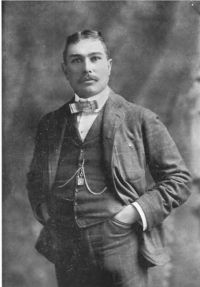
Alexander McMillan Shields

Biographical details

Portrait of Alexander McMillan Shields Alexander McMillan Shields,  The Condor (1899)

“ Here I would mention the apparent apathy of the old Ibis' toward their young; the very instant we approached the nest the old bird would rise into the air and off she would go a mile or more to a feeding ground and frequently not appear while we were in the vicinity. A few weeks before, while collecting Ibis eggs, the parent birds continually hovered overhead or near-by and as soon as we were a few yards from a nest just robbed, the old bird would settle down on its edge and there remain in silence until lost to view among the thick rushes. ”
Source: Wikisource

Portrait of Alexander McMillan Shields Alexander McMillan Shields,  The Condor (1899)

“ WHILE the Fulvous Tree Duck (Dendrocygna fulva Gmel.) is well known to nearly, if not all, our leading authorities and has been made the subject of extended notes by some,–notably Baird, Brewer and Ridgway, very little has been known of its nesting habits. I have made a special study of our Duck family and have personally taken sets of eggs of eight species, but it was not until June of this year (1898) that I had the good fortune to discover the nest of D. fulva, and as is the rule with desirable oological finds, my "take" was quite unexpected. ”
Source: Wikisource

Portrait of Alexander McMillan Shields Alexander McMillan Shields,  The Condor (1899)

“ The eggs partake of the characteristics of both those of the goose and duck, but this is not remarkable when it is remembered that the Tree Ducks constitute a family supposed by some to have originated ages ago from the hybridization of the goose and duck. They are equally at home in an alfalfa patch (about dusk) or in a lake of water, and are entirely at home in an oak forest not far from the breeding swamp, where they are said to assemble for the purpose of feeding on acorns. ”
Source: Wikisource

Get perspective with Kwize: daily news enlightened by great literature