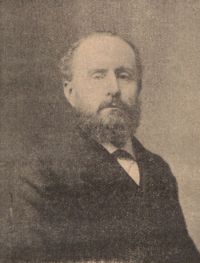
Auguste Longnon

Biographical details

Portrait of Auguste Longnon Auguste Longnon,  1911 Encyclopædia Britannica, Volume 5… (1911)

“ Its name—in Latin Campania, “country of plains”—is derived from the immense plains near Reims, Châlons and Troyes. It was constituted towards the end of the middle ages by joining to the countship of Champagne the ecclesiastical duchies of Reims and Langres, together with the ecclesiastical countship of Châlons. Documents of the 12th and 13th centuries make it possible to determine the territorial configuration of the countship of Champagne with greater accuracy than in the case of any other fief of the crown of France. ”
Source: Wikisource

Portrait of Auguste Longnon Auguste Longnon,  1911 Encyclopædia Britannica, Volume 27… (1911)

“ His son, Herbert II. (902–943) , a man absolutely devoid of scruples, considerably increased the territorial power of the house of Vermandois, and kept the lawful king of France, the unlucky Charles the Simple, prisoner for six years. His successors, Albert I., Herbert III., Albert II., Otto and Herbert IV., were unimportant. In 1077 the last male of the first house of Vermandois, Herbert IV., received the countship of Valois in right of his wife. He died soon afterwards, leaving his inheritance to his daughter Adela. ”
Source: Wikisource

Portrait of Auguste Longnon Auguste Longnon,  1911 Encyclopædia Britannica, Volume 6… (1911)

“ The most important branches of the house of Châtillon were those of (1) St Pol, beginning with Gaucher III. of Châtillon, who became count of St Pol in right of his wife Isabella in 1205, the last male of the line being Guy V. (d. 1360) ; (2) Blois, founded by the marriage of Hugh of Châtillon-St Pol (d. 1248) with Mary, daughter of Margaret of Blois (d. 1230) ,—this branch became extinct with the death of Guy II. in 1397 ”
Source: Wikisource

Get perspective with Kwize: daily news enlightened by great literature