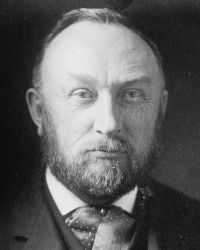
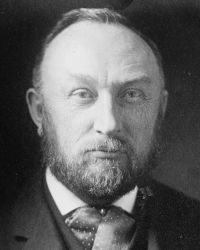
Charles Pritchard and Agnes Mary Clerke

Biographical details

Charles Pritchard and Agnes Mary Clerke 1911 Encyclopædia Britannica, Volume 13… (1911)

It was also after his removal to Slough that he published his first memoir on the construction of the heavens, which from the first had been the inspiring idea of his varied toils. In a long series of remarkable papers, addressed as usual to the Royal Society, and extending from the year 1784 to 1818, when he was eighty years of age, he demonstrated the fact that our sun is a star situated not far from the bifurcation of the Milky Way, and that all the stars visible to us lie more or less in clusters scattered throughout a comparatively thin, but immensely extended stratum.
Source: Wikisource

Charles Pritchard and Agnes Mary Clerke 1911 Encyclopædia Britannica, Volume 13… (1911)

Do the stars also rotate on their axes? or are they sometimes partially eclipsed by the intervention of opaque bodies? And he went on to enquire, What are these singular spots upon the sun? and have they any practical relation to the inhabitants of this planet? To these questions he applied his telescopes and his thoughts; and he communicated the results to the Royal Society in no less than six memoirs, occupying very many pages in the Philosophical Transactions, and extending in date from 1780 to 1801.
Source: Wikisource

Charles Pritchard and Agnes Mary Clerke 1911 Encyclopædia Britannica, Volume 13… (1911)

He concluded that, on the average, the brighter star would be the nearer to us, the smaller enormously more distant; and considering that an astronomer on the earth, in consequence of its immense orbital displacement of some 180 millions of miles every six months, would see such a pair of stars under different perspective aspects, he perceived that the measurement of these changes should lead to an approximate determination of the stars’ relative distances.
Source: Wikisource

Get perspective with Kwize: daily news enlightened by great literature