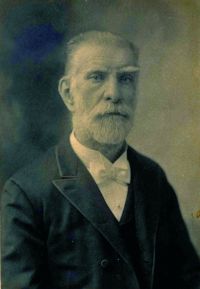
Edward John Hallock

Biographical details

Edward John Hallock,  Popular Science Monthly (1883)

“ That which is poor in bitumen is hard, and rings like ordinary limestone; but the fatter rock, when struck with a hammer, gives forth a dull thud, like a block of wet plaster, and takes an impression from the blow. If it contains more than ten per cent, it crumbles in the hand, and can be cut with a knife, like chocolate. Good stone, with about ten per cent of bitumen, has a specific gravity of 2·1. Some asphalt-stone is of a spongy, hygroscopic nature, and consequently lighter. ”
Source: Wikisource

Edward John Hallock,  Popular Science Monthly (1883)

“ There are several uses to which asphalt may be applied, the most important being the one already so often referred to, namely, as paving material. In Paris about thirty-three miles of street are covered with asphalt pavement, more than three fourths of it being the so-called "compressed asphalt," while the remainder is made of cast or mastic asphalt. The use of asphalt pavements for roadways began in Paris in 1854, since which time their use has been steadily increasing until the present time. In London there are about nine miles of asphalted streets. ”
Source: Wikisource

Edward John Hallock,  Popular Science Monthly (1883)

“ There are several circumstances which indicate that bitumen and asphalt are more nearly related to petroleum than to coal-tar, and that, whether asphalt was made from petroleum or not, they have a similar or common origin. Nor is it an unfortunate circumstance that coal-tar can not be used as a substitute for bitumen, since the former contains many constituents that are more valuable for other purposes, while Trinidad offers an inexhaustible supply of the latter. ”
Source: Wikisource

Get perspective with Kwize: daily news enlightened by great literature